 * 2020 Update: Having just come across his article at astro.cornell.edu, we thought we'd quote NSF astronomy fellow Dave Rothstein:
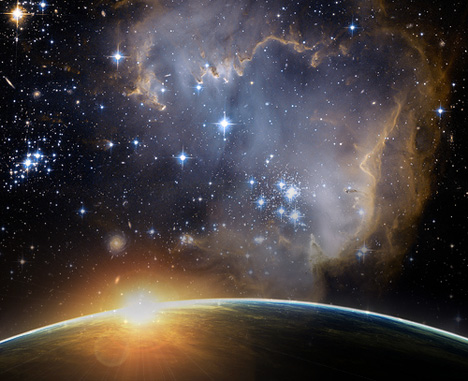
"[E]xpanding" isn't really the best word to describe what is happening to the universe... A more accurate word for what the universe is doing might be "stretching".
Similarly, in 2019, NASA wrote that, "The space between galaxies is stretching..." (See more about this at rsr.org/expansion.)
* 2020 Experiment Proposal: Might it be theoretically possible to triangulate the distance from two distant galaxy clusters to an even further galaxy?
* 2017 Update Stretch Cosmology in Two Major Films! Stretch Cosmology was proposed in the Del Tackett-narrated fathom-event film Is Genesis History? (Tackett makes a cameo appearance of sorts in Enyart's Focus on the Strategy II documentary.) And it was presented in the other recent Fathom Event Genesis: Paradise Lost. (See the link below for its trailer to view the the plants sprouting up out of the ground on Day 3, and consider that as an analogy for how God stretched out the heavens on Day 4.)
* 2013 Update: See this by AiG astronomer Danny Faulkner, A Proposal for a New Solution to the Light Travel Time Problem, in the peer-reviewed Answers Research Journal! Dr. Faulkner mentioned that for the Day 3 creation of plants, God may have supernaturally pulled the plants out of the ground, and that this may be an analogy for how He stretched out the heavens on Day Four, causing the stars to undergo hyper-stellar-nucleosynthesis and actually, though supernaturally, pulling the light from the farthest stars across the universe to the Earth (and perhaps beyond). RSR extends this supernatural stretch cosmology in various particulars including by asking (and answering) why is it that by the end of Day 4 some stars had expended their available energy and others, nearly so, would run out of energy and supernova as observed more recently. And we add the following.
If the supernatural-to-natural boundary (SN2NB), where the laws of physics take over when God rests from His creative work, occurred earlier or later on Day 4, determines whether or not a physics theory is even theoretically helpful to explain how distant starlight arrived during that 24-hour period on Earth. If God supernaturally created the starting conditions after which the light would then naturally propagate to Earth, the SN2NB, at least conceptually, could have been earlier on Day 4 at which point God could watch the laws of physics take over for the completion of that Day's events. God liked His creation and would sometimes use the laws that He had brought into existence to perform even some of His subsequent miracles. So an "earlier" SN2NB is certainly possible. On the other hand, if God supernaturally performed most of what happened on that day, including the stretching of the light throughout the cosmos by miraculous means, that would put the SN2NB, at least conceptually, later on Day 4 and would make unneeded any physical theory about how that light naturally arrived on Earth. In fact if God's supernatural creative act was the effective means whereby light arrived on Earth, then creationist physical cosmologies themselves, while creative and even possibly ingenius, would each represent a dead end. The creation movement would be stronger if theorists and advocates readily communicated where they see the SN2NB and, if possible, why they see it there.
* The Day Three Analogy: The Bible states eleven times in five of its books that God stretched out the heavens (Job 9:8; Ps. 104:2; Isa. 40:22; 42:5; 44:24; 45:12; 48:13; 51:13; Jer. 10:12; 51:15; & Zech. 12:1). Regarding this repeated description, Genesis 1:11 may be literally communicating an aspect of how God created plants, by rapidly and supernaturally pulling them up from the ground. The English word sprout is translated from the Hebrew tad-se, used in Genesis 1 not for the creation of animals but only for plants, and meaning to sprout or to shoot [out]...
Gen. 1:11: "And God said, 'Let the earth sprout vegetation...'"
See an animation of this happening in the first 10 seconds of the trailer for Genesis: Paradise Lost. The Hebrew word translated "sprout" appears in Scripture only in Genesis 1:11. The word daw-shaw', considered related, appears in Joel 2:22, the "pastures are springing up..."
* Stretch Cosmology Proposed Solution: Bob Enyart has temporarily removed from this page RSR's own written SC description because he is considering submitting it to one of the creation journals. This program's 2011 audio, however, remains available (via the above audio controls). Check back here in late 2020 for a possible update. Whereas naturalistic star formation has never and cannot occur by the laws of physics, after the "formation" stage, RSR proposes that the correct answer to the starlight and time question will also explain why stars are at every other possible stage in their lifecycles. (Also, if anyone listens to our 2007 rsr.org/horizon-problem program, if you're interested, please feel free to email Bob@rsr.org and let us know if the guys used the "Day 3 analogy" in that program. Thanks!)
* Stretching the Cosmos, Etc., on Today's 2011 Program: Real Science Radio co-hosts Fred Williams and Bob Enyart discuss more great news stories from the Winter 2012 edition of Creation magazine. And the guys reply to a listener who asks why would a star die and collapse if the universe is only thousands of years old. 2013 Update: After a change of name, the guys now refer to this to this proposal, to solve the starlight and time dilemma, as Stretch Cosmology.
* Is God Outside of Time? Google that question and we think you'll find that of hundreds of thousands of related web pages, that RSR's answer and article is ranked by Google as #1 at rsr.org/time. The well-known claim that time slows down as an object approaches the speed of light also entails that at the speed of light time stops. However, if that were true, then a photon traveling through a vacuum could not have its own innate frequency (i.e., color). But it does.
* Anti-evolutionary Eels, Next-generation Band-Aids, Egyptian Blue, Dawkins Color Vision Challenge, Threes, and Black Holes in a Young Universe: The species of eel discovered in the South Pacific shows stasis, the primary expectation of the creationist (and of renowned evolutionist Stephen Jay Gould), rather than evolutionary change, the expectation of the atheist and of theistic evolutionists.
* New Band-Aids Designed Without Glue By Copying the Gecko Toe: It's about time human engineers got around to reverse engineering the adhesiveness of the gecko's feet in order to manufacture a better Band-Aid. The Band-Aid was invented in 1920, making it eleven years older than the Big Bang which was invented in 1931. See the series of enlargements in the gecko feet image to get an idea of how God used form rather than glue to enable geckos to walk on walls.

 * "Impossibly Modern" Stars, "Primitive Cells," Hominid Fossils, and Information: Real Science Friday co-hosts Fred Williams and Bob Enyart discuss more great news stories from the winter 2012 edition of Creation magazine.

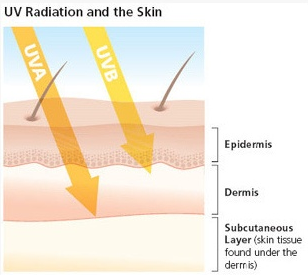 * Resistant Strains Predate Antibiotics, Impact Can't Explain Dino Extinction, Gold Sinks, and Plants Protect Against Ultra Violet Rays: