* Bob Enyart in Round Two with AronRa - Pt3: Discussing YouTube videos #1 and #3 of the series titled, The Foundational Falsehoods of Creation, Bob continues his discussion with one of the web's leading anti-creationists, AronRa.
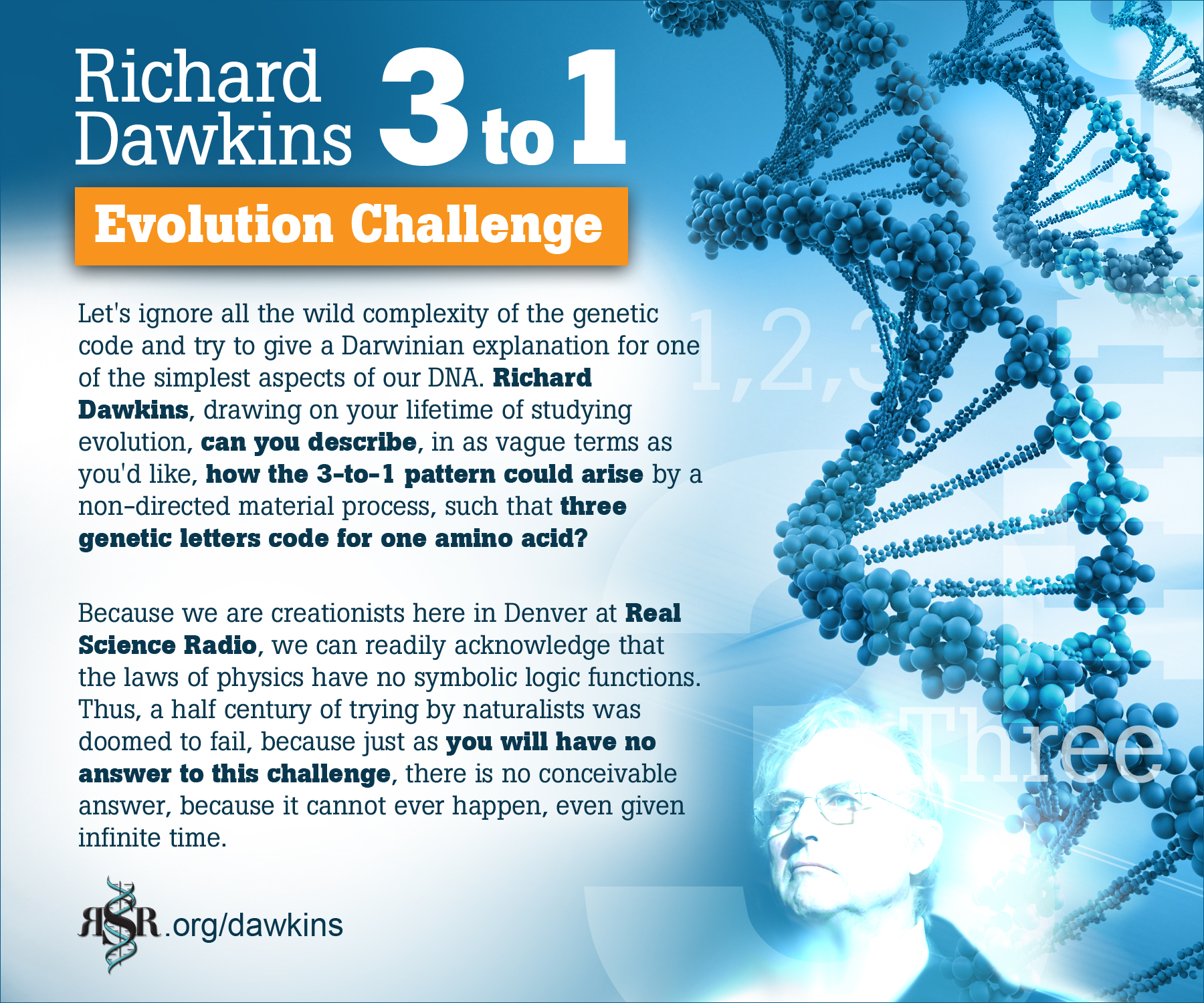
* Sept. 2015 Update -- Richard Dawkins 3-to-1 Evolution Challenge: Research in preparation for an upcoming debate led Bob Enyart and his associate Will Duffy to Oxford University in the United Kingdom. With the success of RSR's PZ Myers Troclea Challenge (see the popular evolutionist's reply here), the guys decided to hand deliver a copy of this Dawkins 3-to-1 Challenge to the office of professor emeritus Richard Dawkins, who lectures there for a course titled, Science Literacy: Evolution for Non-Scientists.
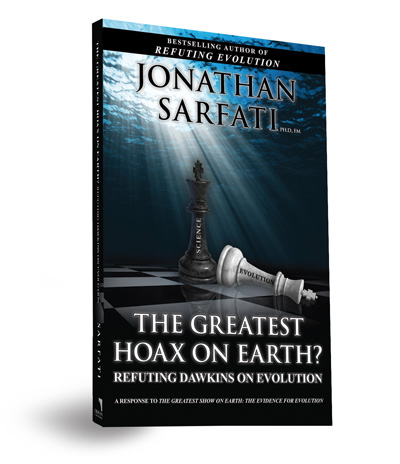
* Dr. Jonathan Sarfati on this Special Edition of Real Science Radio: The world's #1 creation author Dr. Sarfati takes on the world's #1 evolution author Richard Dawkins in the battle of the books. Dawkin's latest book, The Greatest Show on Earth is refuted by Sarfati's The Greatest Hoax on Earth! In this chat with Dr. Sarfati, BEL's producer re-airs a caller from 1997 who asked about Dawkins and Bob pointed out then that in all Dawkins' books
, this famous atheist doesn't give evidence for evolution: he only assumes it is true. Dr. Sarfati agrees and quotes from Dawkins own book in which he admits that he had never given the evidence for evolution. Huh! [Update: In December BEL spliced audio of Dawkins admitting this with our 1997 caller. See it below or on YouTube: Dawkins Proves Creationist Right.)
* Dawkins' Thoughts About Aliens Are Revealing: This is hardly novel, because forensic scientists routinely distinguish between intent and natural causes. But in the excerpt transcribed just below it's fun to see Richard Dawkins, who eschews Intelligent Design, admit that molecular biology may very well be able to identify intentional design in living organisms. Dawkins claims about aliens implies much about alien physiology which seems to undermine the claim that Darwinism is theoretically falsifiable. Consider these two points. First, on Intelligent Design, in Ben Stein's movie Expelled, Dawkins admits that molecular biology could provide the evidence that life on earth was intelligently designed. And if so...
"It could come about in the following way. It could be that at some earlier time somewhere in the universe a civilization evolved, by probably some kind of Darwinian means, to a very, very high level of technology, and designed a form of life that they seeded onto perhaps this planet. Now that is a possibility, and an intriguing possibility. And I suppose that it's possible that you might find evidence for that if you look at the details of biochemistry and molecular biology. You might find a signature of some sort of designer… And that designer could well be a higher intelligence from elsewhere in the universe." -Dawkins
So Dawkins actually says about life on earth that it could be that it may have originated from a higher intelligence, from somewhere in outer space, with aliens who seeded life on earth. Yet that is what ruins scientists careers and even gets them fired: for saying that genetic evidence might indicate that life did not merely arise on earth but was put here by some intelligent agent. And Dawkins is the world's leading evolutionist, and we have him on film admitting the reasonableness of Intelligent Design. Huh! Dawkins' own complaint about his alien segment is stretched to the absurd by his fellow spin-control atheists who have taken his paraphrase of Stein's question to mean that Stein's actual question was edited out of the film. Oh brother. In reality, Dawkins was engaged in his discussion with Ben Stein. Attending a movie marathon, Bob Enyart watched that scene 15 times, and it is obvious that Richard Dawkins was not manipulated or misquoted. Rather, he showed surprising candor when he admitted that the complexity observed by molecular biologists could be evidence that life on earth originated from a higher intelligence. And like Francis Crick, when Dawkins says that life on earth might be too complex to arise here by chance, then he is just punting when he guesses that it could have originated somewhere else.
(2) Richard Dawkins' Alien Evolution Disproves Darwinist Falsifiability: Ostensibly, an alien life form anywhere in the universe (or in the fantasized multiverse) might have no similarity with terrestrial biology, perhaps not even being based on amino acids, sugars, nor even carbon atoms. Thus predictions (which are the stuff of hard science) as used by evolution scientists have no actual real-world specificity, so they cannot even theoretically falsify Darwin's central claim. For in practice, evolution "theory" is pliable enough to account for any observations even if imaginary, like alien physiology. Thus it is treated like a philosophy and not an actual, falsifiable scientific theory.
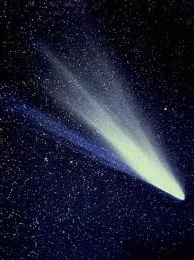
* Hydroplate Expert Kevin Lea Talks about Comets: God did not create the Earth with comets and asteroids aimed at it. So what brought about this danger? In a special edition of Real Science Radio, Bob Enyart and Kevin Lea, a Washington state pastor with a background in nuclear physics, talk about comets: their size, speed, orbits, composition, and lifespan, and origin! They discuss the short lifespans of comets, their composition and orbits, all of which show that comets originated from Earth. The Bible records that the fountains of the great deep broke forth and flooded the Earth and, as it turns out, launched comets into space! Yes, every single comet came from Earth. Check out Walt Brown's fabulous chapter on The Origin of Comets! Hear also the conclusion of this fascinating discussion in RSR: Comets II.
* DRAFT comet animation by RSR:
2013 Update 1: See this fun affirmation of Walt Brown's comet theory, in David Mathisen's comet in the asteroid belt blog. 2013 Update 2: For more evidence for the Hydroplate Theory and its origin of comets explanation, see Comet ISON is Comet 1680 returned. 2014 Update 1: Hubble telescope photographed the "mysterious" breakup of an asteroid. This is not a mystery but instead is expected by students of the hydroplate theory, as explained in Kevin Lea's note below. 2014 Update 2: Asteroid trio gives Earth a close shave (from a triple-blade razor :). 2014 Update 3: In related news, see Pastor Lea's letter to Vladimir Putin regarding Pastor Saeed Abedini unjustly held in an Iranian prison. 2014 Update 4: Cosmonauts find sea plankton on the outside of the International Space Station! 2015 Update: Another confirmed creationist prediction (see just below) this one regarding comets comprised of rounded rocks. 2017 Update: A binary comet/asteroid hybrid has been discovered (see below)
* Another Confirmed HPT Prediction, Rounded Boulders on Comets: Regarding the confirmation of yet another astounding science prediction, in January 2015, Bob Enyart interviews Dr. Walt Brown, author of the hydroplate theory explanation of the global flood and the many resulting broken features of our Earth and solar system. The European Space Agency has just released high-resolution images of Comet 67P along with the assessment of their scientists that they may have found unexpectedly large rounded boulders (up to 10-feet in diameter) that may be the comet's building blocks! This interview presents this latest discovery which, though it has shocked so many secular astronomers, has confirmed Walt Brown's specific prediction, published 13 years ago in the 7th Edition of his book In the Beginning, about the composition of comets. See more at rsr.org/predictions.
* Landslide Photographed on Comet 67P: In a related story and now added to our RSR's List of the Solar System's Transient Events, the European Space Agency has photographed an actual landslide on Comet 67P. Just like every planet and all the other kinds of bodies in the solar system, this allegedly four billion year-old flying pile of rounded boulders produces transient events, that is, passing phenomena, like 67P's landslide and outgassing oxygen, that would be unexpected to see on billion-year-old objects. As for this landslide, of course stable cliffs are not easily built with rounded boulders, so catching a landslide photographically as it happens is not shocking, as it is to old-earthers, but expected, as it is to students of the hydroplate theory!
* Comet 67P Outgassing to Beat the Band: Six weeks of close-up observations show this comet would exhaust its water in just thousands of years! From Dr. Brian Thomas over at ICR:
As the Rosetta spacecraft approached the comet, it measured gas and dust near the comet for six weeks. "In the same period, first measurements from the Microwave Instrument for the Rosetta Orbiter, MIRO, suggested that the comet was emitting water vapour into space at about 300 millilitres per second," according to the ESA. That's over six-thousand gallons per day! At that rate, the whole comet—assuming it's made entirely of water ice—would melt into space after only hundreds of thousands years.
* RSR's ASTEROID LIST: This list is the beginning of our rsr.org/asteroids resources:
- Asteroids are not from an exploded planet. (Their combined mass hardly equates to a small moon.) See RSR's Asteroid challenges naturalism, supports Walt Brown.
- The total mass of the asteroid belt is estimated at approximately 4% that of the Moon and the Moon is approximately 1.2% of the Earth's mass, so the asteroid belt is five hundreths of one percent of the Earth's current mass, and less of it's original mass.
- Asteroids, including the one that struck the Sudan desert in 2006 contain diamonds with inclusions common to diamonds on Earth "such as chromite, phosphate and iron-nickel sulfides", like meteoroids, comets, and TNOs, are composed of minerals common to Earth.
- With the solar system's many old-age-busting transient events, Hubble photographed what is to secularists a "mysterious" breakup of an asteroid.
- We issued our rsr.org/asteroid-prediction in spite of the many asteroids that are known to have moonsand the extraordinarily difficult physics of capturing a moon, yet with all that Kevin Lea and Bob Enyart still predicted that astronomers will continue to be surprised at the increasing number of asteroids found with moons. From rsr.org/predictions...
Asteroids will be shown to have debris fields orbiting them. That is, the percentage of asteroids known to have moons will continue to grow, contrary to materialist expectations (because of the physics challenge of an asteroid capturing one moon, let alone two or more). Also, we will find asteroids with orbiting debris and multiple moons. This standing prediction was partially confirmed when RSR said on September 1, 2017 that there was a significant likelihood that the Florence flyby may show that it has "one or two moons". Five days later, NASA announced and the science media headlines reported, "Asteroid Florence has Two Moons"! Partially confirmed again on July 11, 2018, "Object [2017 YE5] is Actually Two Asteroids Orbiting Each Other & It’s Freaking Scientists Out" per Bustle (of all outlets) and NASA.
- For why many asteroids have moons, see RSR's Asteroid and Meteoroid a Coincidence? and Yet Another Asteroid with Moon
- For the 2017 flyby of asteroid 3122 Florence, based on RSR's creation model, we said that it very well "may have a moon in tow... In fact, it might have a couple moons." Five days later NASA and the science headlines announced: Asteroid Florence has two moons! See more.
- NASA and other sources list the number of asteroids with moons as "more than 150". Johnston Archive as of September 2017 listing both TNOs and asteroids counts over 300 with 286 binaries, 13 triples, and one sextuple, Pluto, for a total of 316 physics-challenging companions. (Personal note to Wm. Robert Johnston: Before you reject our information out-of-hand Dr. Johnston, you owe it to yourself and to your readers to peruse our rsr.org/solar-system-formation-problems and rsr.org/bb pages.)
- A "twin asteroid", 65803 Didymos, in the news in 2017.
- For more on asteroids with moons, see also this nearby asteroid trio.
- Check out our friend David Mathisen's HPT-based comet in the asteroid belt report.
- And how about those peanut-shaped asteroids? :) Well, just check out...
* RSR's List of Peanut-Shaped Asteroids: (See this also at rsr.org/list-of-peanut-shaped-asteroids.) What's with all the peanut-shaped asteroids? In an old-earth scenario by the secular nebular hypothesis and by the laws of physics (see below), these "contact binary asteroids" with their two connected lobes should hardly even exist. But they do. And they're common! Some of the peanutroids, as RSR calls them, are:
- 2015 BN509
- 2006 DP14
- 1999 JD6
- 4179 Toutatis
- Itokawa
- 433 Eros and for good measure
- 624 Hektor, elucidated by Hawaii's Keck Telescope, which is a peanut-shaped asteroid with a moon! See also Nat'l Geographic's report.
- In 2017, 2014 JO25 was discovered to be peanut-shaped!
- In 2018, perhaps 50% of the small bodies in the Kuiper Belt are believed by Lowell Observatory and Carnegie Institute astronomers to be contact binaries according to the Astronomical Journal!
- In 2019, the TNO 486958 Arrokoth, aka contact binary Ultima Thule, was photographed a billion miles beyond Pluto (see below)!
- And don't forget the peanut-shaped comets, some of which are listed just below! (Please notify Bob@rsr.org of corrections or other peanutoids. Thanks!)
* NASA Admits Peanuts Are Mysteries: A NASA mission scientist and member of their Jet Propulsion Laboratory, Donald Yeomans, explained why Itokawa and peanut-shaped asteroids generally contradict the physics-based expectations of old-earth scientists.
It's a major mystery how two objects each the size of skyscrapers could collide without blowing each other to smithereens. This is especially puzzling in a region of the solar system where gravitational forces would normally involve collision speeds of 2 km/sec [4,500 miles per hour].
* Yet 10% of Close-Up Asteroids Are Peanuts: To multiply this peanut evidence against secular expectations, according to old-earth astronomer Dr. Al Grauer with Travelers in the Night, data from the Goldstone Solar System Radar telescope and the Arecibo Observatory in Puerto Rico suggests that of near-earth travelers larger than 650 feet in diameter, more than 10% of these asteroids have a peanut shape. And by the way, so was Arthur C. Clarke's fictional asteroid Kali. And so are the very real comet nuclei of 19P/Borrelly, 103P/Hartely, Halley's Comet, and the famed 67P which (undoubtedly like countless others) is known to be made up of millions of rounded boulders. Remember, all scientists work for Walt Brown!
Hubble: binary asteroid/comet hybrid 2016
* Binary Comet/Asteroid: Again from our all-scientists-work-for-Walt-Brown file, in September 2017, from our all-scientists-work-for-Walt-Brown file, the journal Nature published the discovery of 288P, a binary asteroid/comet hybrid. Wow! "Rapid rotation" is one of the (unworkable) explanations claimed by secular astronomers for binary asteroids. Secular astronomers, though mostly ignorant of the Hydroplate Theory formation of comets and asteroids, nonetheless make frequent discoveries consistent with and in confirmation of HPT creation science predictions!
* Peanut Asteroid Craters? Would peanut-shaped asteroid impacts form circular craters? Or might their craters, depending on their orientation at impact, be somewhat deformed? National Geographic published a list of the ten biggest known impacts on Earth. Do any of them appear to have been caused by a peanutroid? With perhaps just over ten percent of the larger near-earth asteroids being peanut shaped, that alone might suggest why we may never have been hit with a peanut-shaped asteroid. Or, might an understanding of the origin of asteroids (and of comets, meteoroids, and TNOs) help to explain why it would be even less than statistically likely that we would get hit by a dually than by a unary impactor?
* 2019 Photo of Another Contact Binary: NASA's New Horizon, a billion miles past Pluto, photographed yet another contact binary TNO 486958 Arrokoth, Ultima Thule! Previously, regarding such binaries (or snowmen), in a moment of candor NASA admitted that such "peanuts" are mysteries. Mission scientist and member of the Jet Propulsion Laboratory, Donald Yeomans, explained, "It's a major mystery how two objects each the size of skyscrapers could collide without blowing each other to smithereens. This is especially puzzling in a region of the solar system where gravitational forces would normally involve collision speeds of [4,500 mph]." All scientists work for Walt Brown!
* 2018 Photo of Another Flying Rockpile Asteroid: All scientists work for Walt Brown, including in Japan! The Japanese Aerospace Exploration Agency landed two small rovers on the asteroid Ryugyu on Sept. 21, 2018 and found yet another HPT-compliant flying rockpile!
* And here's Asteroid Bennu: Another HPT-compliant flying pile of rubble...
* NASA on the Yarkovsky Effect: [Sept. 2019 update.] From the 2-minute interview of NASA's meteor specialist Helena Bates by London's NHM. "Most of the asteroids in our solar system... are between the orbits of Mars and Jupiter but there are a number of them near, what we call, Near Earth Space." On predicting the orbits of asteroids, "the problem with very small bodies are that they're affected by things that we didn't initially assume that they would be affected by. And one is the effect of the Sun which is called the Yarkovsky effect. [T]he Sun heats up one side... and then as [the body] rotates that side will begin to face away from the Sun and will radiate that heat outwards. That basically acts like a small thruster to push the asteroid into a slightly different orbit." And because meteoroids and asteroids can have varying composition, it's "really hard to predict the effect of the Sun."
* Thanks to an RSR Volunteer: RSR thanks one of our volunteer researchers for transcribing the JPG image of John Buchanan's 1905 Letter to the Editor. The image and transcription of the insightful, anti-evolution letter are over at rsr.org/john-buchanan.
 , this famous atheist doesn't give evidence for evolution: he only assumes it is true. Dr. Sarfati agrees and quotes from Dawkins own book in which he admits that he had never given the evidence for evolution. Huh! [Update: In December BEL spliced audio of Dawkins admitting this with our 1997 caller. See it below or on YouTube:


 2014 Update 3: In related news, see Pastor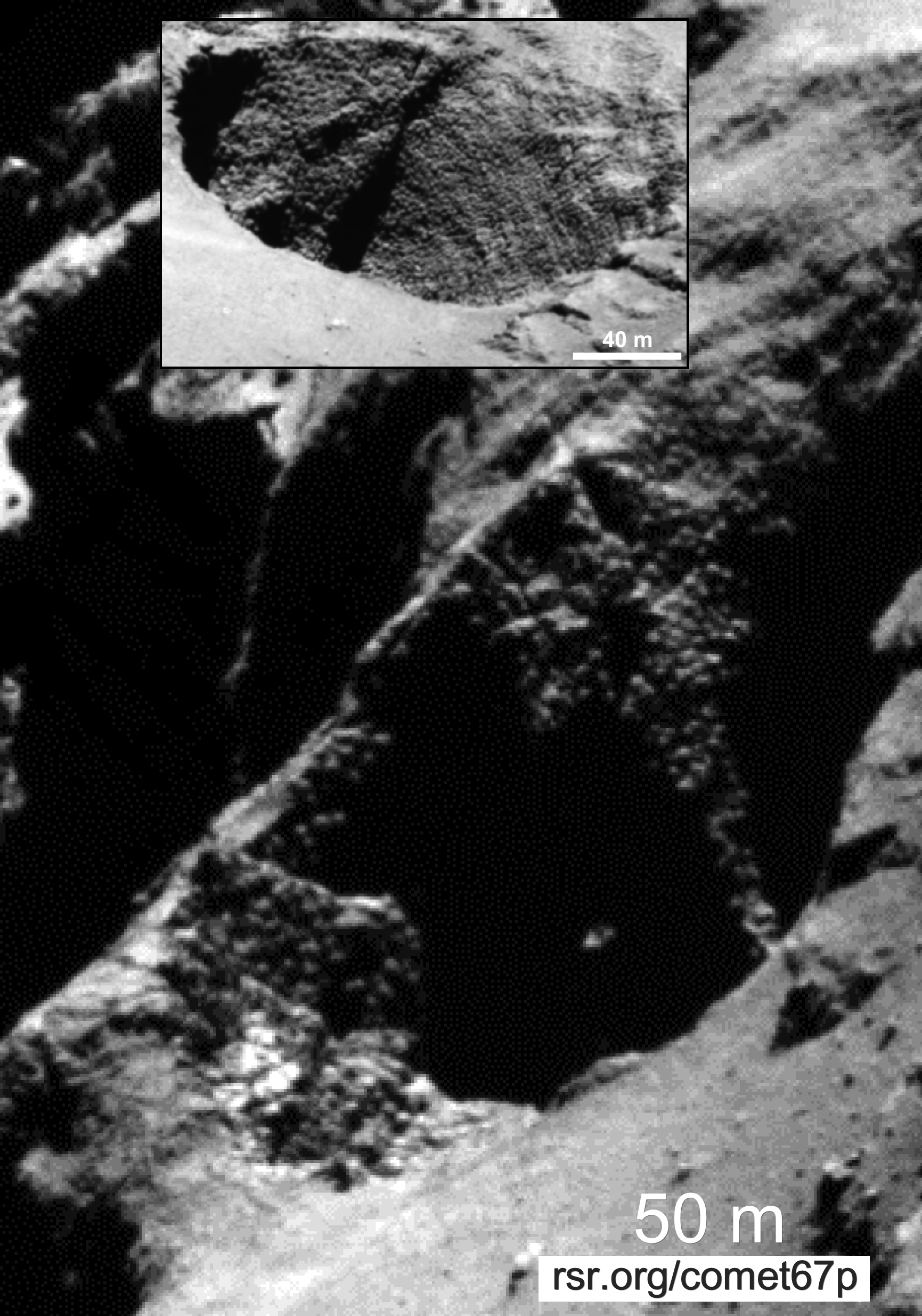


 * Peanut Asteroid Craters? Would peanut-shaped asteroid impacts form circular craters? Or might their craters, depending on their orientation at impact, be somewhat deformed? National Geographic published a list of the

