Bob Enyart and Fred Williams complete Real Science Radio's List of 25 Ways the Shutdown Kills People. See the full written list at rsr.org/25 and links to various scientific studies showing how increased death results from economic decline. We've noticed leftists and other Democrats getting angry at this list. But, if you're a conservative Christian, hold onto your hat! Because you might get mad at the guys yourself as they begin today's program quickly calling out their List of 25 COVID Christian Conspiracies.
* List of COVID Christian Conspiracies: from the conservative pastor of DBC, after first angering the left with our 25 Ways the Shudown Kills People, now we've angered many on the right, our own natural consituency, with our list of COVID Conspiracies. Millions of Christians lacking discernment swallowed whole each of these absurdities, many of which are contradictory, and risk their mental health by indulging their paranoia...
 - the coronavirus was never a real threat
- the government planned the pandemic (as a power grab)
- the media planned the pandemic (to get Trump)
- the global elite planned this (toward ushering in the anti-Christ)
- Fauci who had said "it's coming" planned this (to make money)
- China planned the pandemic (but first infected itself)
- the CDC planned this (advertising in 2019 for pandemic workers)
- the virus is a Plandemic (even though its clearly natural)
- somebody, doesn't matter who, planned this (says my paranoia)
- this virus can't be natural ('cause then I can't indulge my paranoia)
- a SARS or COVID virus could appear naturally only every 800 years
- China created this as a biological weapon (then infected itself)
- people can contract SARS-CoV-2 from the flu vaccine
- masks increase your risk of contracting the coronavirus
- Bill Gates is creating a vaccine to kill millions of people (depopulation)
- God's command to not bear false witness doesn't apply to me
- KS City ordered churches to turn over membership roles
- coronavirus test kits are infecting people with the virus
- the Mark of the Beast is a vaccine (Of course! How could it not be!)
- any conspiracy always explains whatever crisis occurs
- COVID deaths, relatively small in number, are highly exaggerated
- $39k paid for each ventilator use (So what? Most have gone unused.)
- government plans to forcibly remove children from homes
- 5G wireless technology helps to spread the coronavirus
- churches have been shut down but not mosques
- medical examiners are attributing traffic deaths to COVID
- the CDC designed guidelines to overcount COVID deaths
- the CDC quietly reduced COVID death count by 23,000 (and see below)
- the COVID vaccine is unsafe (yet one doesn't even exist)
- Fauci profits from a (non-existent) HIV vaccine and will from COVID
- the left is using this crisis (yes, but they use everything, even normalcy)
- to receive any of the $100 billion HR 6666 testing money institutions must require everyone entering their facilities to have taken the (non-existent) COVID vaccine.
COVID Leftist Conspiracies:
- Trump-led racists fabricating Wuhan lab origin
- Those urging return to work want people to die
- HCQ used safely for 60 years now a very dangerous drug
- _________ please send suggestions for leftist or Christian conspiracies to Bob@kgov.com. Like the people in the Bible and taking the Lord as an example, we are far more interested in confronting bad behavior among us Christians, and exposing the misinformation spread by believers, than we are in talking about the overtly obvious left-wing conspiracies.
Understanding the Shutdown without Conspiracies: and please send suggestions for this section to Bob@kgov.com.
- For decades epidemiologists have proposed shutdown mitigation ideas
- Mankind through the 1900s lacked the wealth to even try a shutdown
- In late 2019 SARS-CoV-2 jumped from bats to a Wuhan laboratory staffer
- That Wuhan lab worker spread the disease in the Wuhan wet market
- The communist Chinese lied and covered up igniting a pandemic
- The World Health Organization dutifully repeated China's misinformation
- President Donald Trump insightfully cut off the US from China
- Fauci, the media, the Dems, and the WHO condemned the "overreaction"
- May 12th Trump announces unprecedented cutoff of US from Europe
- We conservatives, also fearing the virus, did not criticize cutting off Europe
- US media and all the left flipped position to now claim Trump underreacted
- Epidemiologists, security consultants, etc., given a free hand, will overreact
- Prosperity meant eventually nations would try the epidemiologist proposal
- Europe's nations closed their borders and not for conspiratorial reasons
- First time ever millions (all liberals) hope a drug, HCQ, fails to save lives
- Shutdown flattens the "curve" but as at rsr.org/25-ways it also kills people
- Leftists and epidemiologists seem oblivious to mass death from recession
- NY Gov. Cuomo's Dept of Health ordered nursing homes on March 25th (and reversed on May 10th), "No resident shall be denied re-admission or admission to the NH solely based on a confirmed or suspected diagnosis of COVID-19. NHs are prohibited from requiring a hospitalized resident who is determined medically stable to be tested for COVID-19 prior to admission or readmission." That incompetence led to approaching 5,000 deaths, or nearly 25% of New York's fatalities while hundreds of emergency hospital beds went unused at the Javits Center and on the USNS Comfort.
- Late January to late March when a tiny fraction of Americans were dying from the coronavirus, the epidemiologists had justification for their predictions that a major wave of death was coming soon, whereas many pro-Trump conservatives were solidifying a premature belief, based on what they were seeing, that this disease was a minimal concern.
- As worldwide daily fatalities for this brand new cause of death race past those of most recent endemics and pandemics and have tied malaria and AIDS and approach pneumonia, U.S. fatalities have average 1,800 deaths daily and higher for a number of days in April and May 2020, and for that duration COVID-19 was the #1 cause of death in America...

- Millions of Christians swallowed whole the rsr.org/COVID-conspiracies
- Conspiracy allegations make it harder for politicians to back down
- The cure is worse than the disease per rsr.org/25-ways-the-shutdown-kills
* Wuhan Flu: Those who seek to hold the Chinese communist government accountable for the lies and cover-up behavior that ignited the pandemic can use this map of China coated with the widely-recognized SARS-CoV-2 virus graphic...

* Biblical Principles Related to a Drastic Epidemic Mitigation: Consider historical accounts and biblical principles from Joseph, Moses, Nehemiah, and Jesus Himself. In the Book of Leviticus Moses wrote God's commands regarding infectuous disease mitigation 3,000 years before the age of microbiology ushered in by creationist Louis Pasteur. The Lord instructed the Israelites to quarantine, wash, observe, and even at times burn the personal effects of the infirm. That quarantine, of course, was for the person who was ill, and this was for the particular infectuous disease the Israelites were facing at that time. A biblical teaching from a couple centuries earlier in sacred history that is related to drastic action taken by a government in the face of a possibly existential threat comes from the time of Amenemhat III. (He's the source of the ancient expression, Amen, make it so.) The reason that God revealed the coming famine to Joseph was so that the Egyptian government could prepare for a looming drought. Pharaoh undoubtedly expropriated land over the nine miles of what is still today called the Waterway of Joseph. That Bahr Yussef brought the Nile's water to Birket Karun, quadrupling its water acreage. Also undoubledly, thistook a tremendous number of lakefront properties, when Birket Karun became the massive ancient Lake Moeris, filling that valley to become a huge resevoir. Joseph was not known as one of the twelve patriarchs of Jacob at that time, and any displaced landowners, even any who happened to believe in the Creator of the world, if they held the same position as many right-wing Christians today, would have fiercely objected: "The government has no just authority to take away my God-given right to control my own private property! And besides, look at the weather. Looks fine to me! There's no drought in site!" (Sounds like many Christians in January, February, and March 2020. See the almost non-existent daily deaths for those months, above.) When God authorized Nehemiah to return to Jerusalem and build the great wall of the city to mitigate possible future death from invaders, the descendants of Jews and others who had escaped Nebuchadnezzar's army seventy years earlier were living among the rubble of the cities overthrown. Undoubedly here too God's authority extended to the appropriation of land for the wall even over any objections of current residents. "You're not building a wall across my land!", to which Nehemiah if he were in a good mood would have said to his men, "Ignore him." Consider also the significant implication of Jesus' teaching that man was not made for the Sabbath but the Sabbath for man. Selah.
 * Masks: The world's mitigation efforts have suddenly promoted a medical industry question of effectiveness into a public controversy. For the sake especially of medical staff, hopefully we will improve our understanding of the dynamics involved, even after a hundred years of enormous experience and a lot of study. In 1977 smallpox, a disease from a highly transmissible airborne virus, was eradicated. Three of ten victims died. In case of a reemergence, nursing protocols reiterated even this century call for those around a suspected case to wear masks. With all our conspiracy-minded friends have learned against masks, undoubtedly each would still wear a mask if their work (or love) required them to be around folks like that poor girl, shown here. The mask conspiracy item listed above states the false belief that those who wear masks increase their risk of transmission. Such conspiracists must conclude that over the last century those who wore masks to minimize risk actually increased disease transmission. It appears thast most of those who come to that conclusion and who are also angered thereby don't assume that recommending masks is a well-meaning but ill informed policy, but rather, there must be nefarious reasons motivating the thousands of medical experts who advise wearing them. This later is an indication of a progressing mental health issue evidenced by paranoia.
* Traffic Deaths Being Marked as COVID: If you play a trick on your Christian friends and read any of a thousand Bible verses to them, not telling them it's from Scripture, about half will say they disagree with what you've just read. So when Christians en masse instantly accept the claim that coroners are marking traffic fatalities as COVID deaths, that overwhelming uncritical acceptance alone is a good indicator that, as it appears on it's face, it's fake news. Here's a typical BEL email correspondence...
Forwarded Conversation
Subject: "My cousin knows somebody?"
------------------------
From: K********
Date: Thu, May 14, 2020 at 8:44 AM
To: Bob Enyart <bob@kgov.com>
Bob, I gave my friend a link to your program, and he did enjoy it. But our text exchange went as follows. To my friend:
Didn't u say u knew someone whose kid died in a wreck but they put COVID on her death certificate and he has to fight the hospital to change it for insurance purposes? It's interesting all the messages around that start with "my friend knows someone" or "my brother knows someone" etc.
His response:
Yes. And I heard it again from my doctor Monday. He has a client who’s son just died in a motorcycle accident in Vancouver. They listed the death as Covid. Also my buddies grandmother who was 92, no Covid symptoms, just old, week at the end of her life died in the hospital of natural causes. Listed as Covid. I know a girl in Hawaii that just had a friend pass of pancreatic cancer, listed as Covid. No conspiracy when you hear it over and over again.
Sent from my iPad
----------
From: Bob Enyart <Bob@kgov.com>
Date: Fri, May 15, 2020 at 9:19 AM
To: K********"
Cc: B********
Hey K*******! I've cc'd our dear friend and graphic artist extraordinaire B****** because of the Vancouver area traffic deaths, two of the more tragic ones were children from his town. B..., if you're aware whether the local news reported a recent motorcycle death in the Vancouver area, please let us know. I'm fishing out another spreading conspiracy for our RSR show for May 15th and for our list at rsr.org/covid-conspiracies.
K*****, using my lie detector mode, when I read the above exchange, I'm thinking as though I'm interviewing a suspect's friend, and I'm spotting evidence of evasion and likely false information...
Q: Didn't u say u knew someone whose kid died in a wreck but they put COVID on her death certificate and he has to fight the hospital to change it for insurance purposes?
A: Yes.
Oh really? And that's it? With such a pointed question, the only answer is, Yes. Not, "Yes," and then offer the identity of the gal who died, or at least your friend's identity? What's missing that would appear in a truthful answer is: "Yeah, it was Jerry Berry's kid brother, Mark. He died last Tuesday over on Main and 15th. It was a reall mess." But instead of details about the case he knows of personally, he then obfuscates by throwing in questionable and likely uncheckable details about a different case.
A continues: And I heard it again from my doctor Monday. He has a client who’s son just died in a motorcycle accident in Vancouver. They listed the death as Covid.
Ah, now he gives more details than he just did for the person that he knew. But it turns out that traffic deaths in Vancouver and its surroundings, like in all major cities, are contemporaneously reported and in the last month according to local and Canadian media there were:
- three motorcycle accidents in the past month and as of a report six days after the one with the most serious injuries, no report of fatalities
- a baby boy was killed and parents injured in a rollover crash on Highway 97 C
- two Abbotsford children killed when drowning in a crashed and submerged ATV
- a Vancouver island pilot killed in a far-distant Canadian miltary helicopter crash
- two fatal boating accidents in the last ten days
- new recommendations from a fatal train crash a year ago
- finally charges issued in a nearby Malahat crash two years ago
- but no fatal motorcyle crashes [UPDATE: other than the tragic one that B***** found from November, which he truly doubts was marked as COVID related.]
And even if there had been, the doctor's account would have turned out to be false. Doctors are hardly less susceptible to personalizing the conspiracy theories they spread than are others. And ironically, there's undoubtedly a slightly paranoid doc in Vancouver who's saying a motorcycle death in your friend's city was marked as COVID. (Televangelist faith healers know that trick. They tell donors in Singapore that God raised someone from the dead in Kansas City and when in KC say they did that in Singapore. Piece 'o cake.)
A continues: [with two examples that were not fatal crashes marked as covid deaths]
These just add details that even if true wouldn't corroborate the original false statement but they're meant to imply that they corroborate it. Lies often are detectable by the details added in order to make them sound more believable. Like, the friend "has to fight the hospital to change [the cause of death] for insurance purposes." Oh, really? Right.
Overcounting and undercounting obviously both occur and both for unavoidable and for bias reasons, and often these cancel each other out and regardless, because the number of cases is by far the greater factor, getting the count "accurate" is not as important as most people think. If millions of people are infected, and a hundred thousand people are claimed dead from the virus, but the deaths were overcounted by double, that would mean that, for example, the death rate was 0.02 instead of 0.01. The overcounting, and the undercounting (as with nursing homes and via state governors who want to look like they did a great job reducing deaths), these factors both go into the number in the numerator, and it's the denominator, that is, the number of cases, that is so vastly greater, that makes the difference in evaluating the real world happenings. UPDATE: At any rate, K****** just emailed:
It's obvious some of that overcounting went on. But the "I know someone's sister" ... is all over. "My wife's a Farmers insurance agent and just last night a fellow agent said one of his 'prospects' told him a similar story.
Thanks K******, I'm obviously not saying the doc or your friend are going to hell because of this. (People go to hell if they reject Jesus Christ.) But I am admonishing them and ten thousand others by pointing out that regarding God's Ten Commandments, when they're endulging their paranoia, they believe they can reject His command, as maybe the Amplified Bible would put it, "Do not bear false witness against your coroner." They're so sloppy with the retelling of stories, and so eager to have people believe them, that like with the game telephone, only somewhat intentional, each time they or someone else repeats what they've heard or read on social media they have the opportunity to falsely remember/misspeak/personalize the story or add a detail they imagine must be true, in order to make the claim sound more convincing. When it comes to fake news, the left has nothing on the right. After all, they say, never let a crisis go to waste.
Thanks K******.
In Christ,
- Bob Enyart
KGOV.com - RealScienceRadio.com - rsr.org

 * Head-banging: As reported by LiveScience, cutting-edge researchers running a major National Science Foundation evolution experiment admitted that, "If Darwin was right", they would have documented the evidence for his claimed insight on competition and the (supposed) tree of life. Instead, their results falsified Darwin's claim. Of the 60 species of algae being studied for a five year period, Charles Darwin predicted how well and how poorly such organisms would compete for resources, based on their respective distances from each other on the (supposed) tree of life. But of the outcome, "It was completely unexpected. We sat there banging our heads against the wall. Darwin's hypothesis has been with us for so long, how can it not be right? ... We should be able to look at the [supposed] Tree of Life, and evolution should make it clear who will win in competition and who will lose. But the traits that regulate competition can't be predicted from the Tree of Life." For more, see LiveScience and rsr.org/darwin-was-wrong-about-the-tree-of-life.
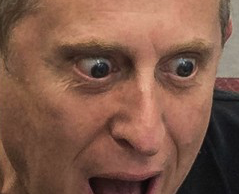 * Socks Blown Off: Close-up photos showed the youthful appearance of Pluto as did the images of its largest moon: "We originally thought Charon would be an ancient terrain covered in craters," said New Horizons team member Cathy Olkin. "So when we saw the pictures this morning, it just blew our socks off." And panning upward from their feet, Discover Magazine reports on NASA's Pluto team including principal investigator Alan Stern's eyes popping out of his head.



 - Increasing family debt leads to increased stress (which kills, see