
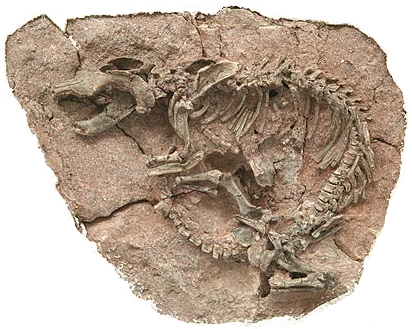
 * 432 Mammal Species in Dinosaur Layers: (438 by 2020. See below.) Dr. Carl Werner's research of the world's leading museums presents amazing findings. Did you know that mammals ate dinosaurs? Co-hosts Fred Williams and Bob Enyart discuss Don Batten's interview of Dr. Werner and how museums downplay the 432 mammal species excavated by paleontologists from dinosaur layers. Fred is with the Creation Research Society, and on this episode of Real Science Radio the guys again draw from both the latest issue of Creation magazine, April - June 2011 and the Winter 2011 CRSQ Creation Research Society Quarterly.
* Dinosaurs ATE Birds :) In a related development, another dinosaur has been discovered with birds in its stomach, which is certainly interesting considering the claim that dinosaurs evolved into birds (like from Jack Horner).
* Mammals ATE Dinosaurs :) See below.
* Bear Prints in Famed Permian Deposits: From 250 million years before bears were supposed to have evolved...

* Bear Prints among the World's Most Famous Permian Tracks: (2020 Update: This bear species brings Dr. Werner's total number of mammal species identified in dinosaur-layer and deeper strata to 438.) If the above "Unexplained bear-like" prints, as the July 1992 Smithsonian describes them, were in fact made from a bear, then we can add a bear species to Dr. Werner's list of mammal fossils found in Mesozoic and Paleozoic layers. The two Permian tracks (in stone, above) were uncovered in New Mexico by Jerry MacDonald in an area designated in 2009 as the Prehistoric Trackways National Monument. RSR believes that the species that left these tracks may be the largest mammal so far documented from dino-fossil bearing and deeper strata.
He's got several tracks where creatures appear to be walking on their hind legs, others that look almost simian. On one pair of siltstone tablets, I notice some unusually large, deep and scary-looking footprints, each with five arched toe marks, like nails. I comment that they look just like bear tracks. "Yeah," MacDonald says reluctantly, "they sure do." Mammals evolved long after the Permian period, scientists agree, yet these tracks are clearly Permian.
... The fossil tracks that MacDonald has collected include a number of what paleontologists like to call "problematica." On one trackway, for example, a three-toed creature apparently took a few steps, then disappeared—as though it took off and flew. "We don't know of any three-toed animals in the Permian," MacDonald points out. "And there aren't supposed to be any birds." -Smithsonian July 1992, p. 78
Birds of course allegedly evolved from dinosaurs, about 200 million years, allegedly, after these tracks were made.
Related: See the following dinosaur soft tissue video and learn about surviving dino red blood cells, blood vessels, and even DNA as reported in 50+ papers published in the world's leading science journals and linked to from bflist.rsr.org.
* 2013 UPDATE Now 435 Mammal Species in Dinosaur Layers: Beginning with Dr. Werner's 432 species, we add the three Jurassic apparently tree-dwelling squirrel species,
* 2015 UPDATE Now 436 Mammal Species in Dinosaur Layers: An 5-inch fossil skull excavated on Madagascar resembles that of a modern groundhog, only double the size. See this in the Spring 2015 Creation magazine and at the National Science Foundation's website.
* Dinosaurs Co-existed with Mammals: For additional perspective on our interview with Dr. Werner, from the 2013 Spring CRSQ, "even though evolutionists have grudgingly accepted mammalian and dinosaurian co-existence in recent years, they have not always done so" (Robert Brown, Otis Kline, et al. 2013. A Partial Mandible in the Stomach Contents of a Tyrannosaurus rex. CRSQ 49(4):265-280). RSR friend Kline and his co-authors also wrote that, "The [mammal prey] evidence, which revealed itself so quickly in this study, suggests that a biblical starting point would have advanced dinosaurian knowledge by decades."
* Mammal Species in Dino Layers Downplayed: From Dr. Batten's great interview of Carl Werner: "Paleontologists have found 432 mammal species in the dinosaur layers; almost as many as the number of dinosaur species. … But where are these fossils? We visited 60 museums but did not see a single complete mammal skeleton from the dinosaur layers displayed at any of these museums. This is amazing." See this documented in Dr. Carl Werner's tremendous DVD, Living Fossils!
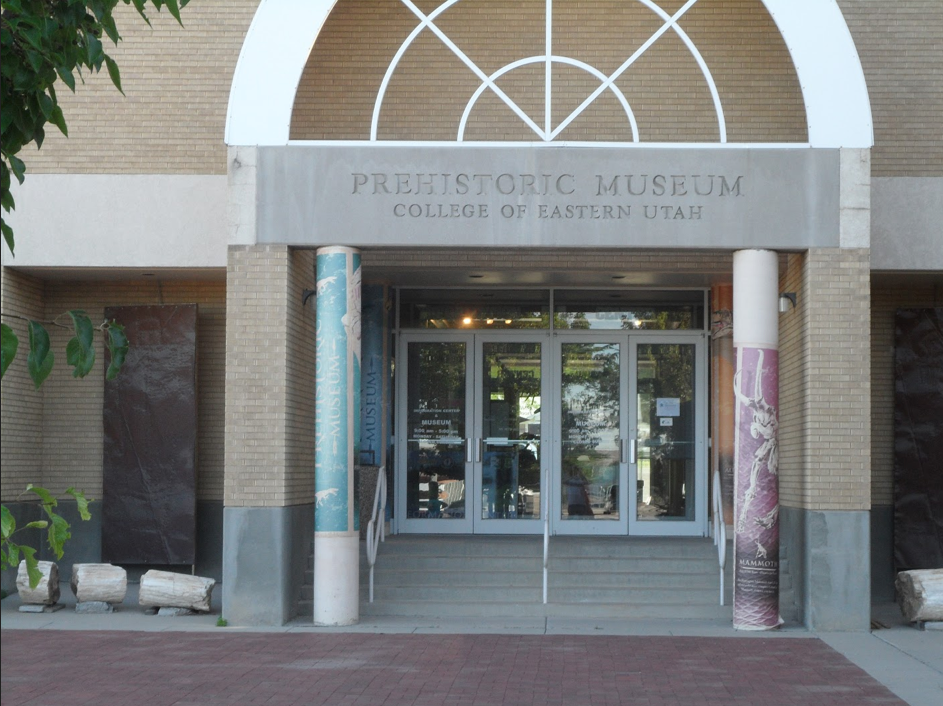 * Evolutionary Paleontologist Describes Mammals Everywhere: “We find mammals in almost all of our [dinosaur dig] sites. These were not noticed years ago," said Dr. Donald Burge, curator of vertebrate paleontology at the Prehistoric Museum of Price, Utah. Great quantities of hard data that don't fit the evolutionary bias can be almost invisible to the entire scientific community, as for example countless countradictory "radiometric" dates and galaxies worth of evidence against the big bang. "We have about 20,000 pounds of bentonite clay," continued Burge, "that has mammal fossils that we are trying to give away to some researcher. It’s not that they are not important. It’s just that you only live once and I specialized in something other than mammals. I specialize in reptiles and dinosaurs." That's not surprising. Specializing in Jurassic-layer mammal fossils would not exactly help a Darwinist's career! See rsr.org/slaughter.
* See Online Carl Werner's List of Living Fossils: Dr. Werner's List of Living Fossils was put online by RSR with the help of ICR's Brian Thomas. While Wikipedia's list of these "Lazarus" fossils is helpful, Carl's list is even more valuable because it records which layer or layers (i.e., "periods" or systems), the Triassic, Jurrasic, or Cretaceous, that a fossil was excavated from. Our online list is nothing but text, whereas Dr. Werner's DVD has the 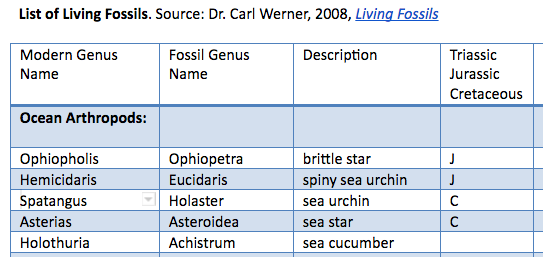 highest production value and his hardcovered Living Fossils work is as beautiful as any coffee table book. Both the DVD and the book are filled with stunning photographs documenting the fossils and the living organisms. RSR highly recommends both of these valuable resources! You can purchase the beautiful Living Fossils book and DVD by clicking those links!
* 100-Million-Year-Old Mammal Hair: Found in France, Mammalian hairs in Early Cretaceous amber, which is allegedly 100 million years old. That means these mammals, with hair like today's mammal hair, would have been alive 35 million years before the dinosaurs went extinct.
* The Pygmy Whale Living Fossil: In case you're interested, yet another living fossil was discovered, the Pygmy Whale, a member of "a group thought to have gone extinct 2 million years ago." This LiveScience article is also interesting for its acknowledgement of the extremely flexible methodology evolutionists use to try to show common descent. For example, note how Darwinists could select from DNA, or the shape of the snout, or to general similarities in the fossil record, or specifically to the skull, to make a claim of what evolved from what.
* Squid Ink Correction: Bob Enyart starts the show with a correction about the allegedly "150-million" year old squid fossil which did NOT have liquid ink as Bob had erroneously stated. The media reported that, "the black ink was of exactly the same structure  as that of today’s version," but it was rehydrated with amonia and water to be used as ink. See the full correction. And as Dr. Carl Wieland writes about why this ink is not millions of years old, "Chemical structures 'fall apart' all by themselves over time due to the randomizing effects of molecular motion."
- Bone Valley: Just as Yellowstone's interpretive sign has now been removed that had wrongly presented a just-so story of the repeated appearances and destructions of forests which had supposedly left behind a handful of petrified trees on more than a dozen strata, the Bone Valley story will eventually be dropped also. Fossilized marine and land animals, from sharks and whales to mammoths and saber-toothed cats, to many marine and land plants, tell the story of the global flood from central Florida. Tom DeRosa reports on Bone Valley at the University of South Carolina Lancaster, South Carolina, in the CRS Conference Abstracts.
* Lucy in the Skull 1470 with C14 in Diamonds: Huh? Bob and Fred enjoy recollecting some Lucy and Skull 1470 trivia. And see our List of Not So Old Things for the Carbon-14 in diamonds.
 * RSR Shows about Dr. Carl Werner's Work:
- What Museums Aren't Showing You (this show)
- June is Whale Month on RSR (groundbreaking series)
- Rodhocetus: Whale of a Tail
- Dr. Carl Werner and the Living Fossils
- Many Modern Birds Found in Dinosaur Layers
- 2014 Breaking News: Whale Fossils Faked
Today’s Resource: Have you browsed through our Science Department in our online store? Check out especially Dr. Carl Werner's Vol. 1 Grand Experiment and Vol. 2 Living Fossils DVDs! So just click to order any of our RSR science products or call us at 1-800-8Enyart (836-9278).
* Special Editions of Real Science Radio:
- BEL's famous List of Not So Old Things
- Bob's debate with Christian Darwinist British author James Hannam
- PZ Myers blogs against Real Science Radio so we hit back with the PZ Trochlea Challenge
- Waiting for Darwin's Other Shoe: Science mag cover: Darwin Was Wrong on the Tree of Life
- Microbiologist in Studio: Creation Research Society Quarterly editor on new genetic findings
- Caterpillar Kills Atheism: describe how a bug could evolve to liquefy itself and then build itself into a flying creature
- And see the RSR Offer of $2,000 to get 16 letters of the alphabet in their correct places; $500 paid in 1998; $1,500 in 2010...
* National Geographic Dinner Menu: Excerpts from NG's Dinosaur Found in Mammal’s Belly...
Early mammals were not only bigger than previously thought—some were carnivores and hunted small dinosaurs for dinner.
...two mammals that lived around 130 million years ago... will revolutionize current thinking about... a time when both dinosaurs and mammals arose.
...incredibly well-preserved fossil—of an early mammal... had the remains of a small dinosaur in its belly...
The second fossil... is 50 percent larger... Until now R. robustus was the largest known mammal of the Mesozoic era.
...the first hard evidence that Mesozoic mammals were more than the rat-size plant- and insect-eating creatures that they have long been portrayed to be... "giving us a drastically new picture..." said Jim Meng, associate curator... American Museum of Natural History.
The R. giganticus... a young adult that weighed about 30 pounds... was more than 3 feet (1 meter) long... the size and shape of a small- to medium-size modern-day dog... larger than most species of living [extant] mammals."
...the dinosaur was about one-third the size of the R. robustus that ate it.
Rethinking the Mesozoic
As little as two decades ago, schools taught that the dinosaurs ruled the Earth from 248 million years ago until some still-unknown catastrophic event caused their extinction around 65 million years ago.
Mammals also evolved during this period. [RSR asks, when was that first taught?]
... Mammals were not thought to have grown much bigger than rats until after the dinosaurs were gone.
* Bone was Always Bone: A 2013 paper in the journal Bone which announced the first confirmed discovery of dinosaur DNA (from a T. rex), also referenced a 2007 Journal of Paleontology paper that studied what is claimed to be the "oldest" bone fossil discovered from the "late" (i.e., upper strata) Devonian. In reality, with a margin of error as long as the age of each specific animal, all of the bones recovered from the vast amount of strata in the world which were deposited by the global flood, are the same age. The 2007 paper discovered what creationism of course predicts, that the "earliest" bone (allegedly ~360 Mya) had sophisticated features that we find in living creatures today, including the branching channels between the lacunae. Pockets (lacunae) are the many microscopic spaces systematically located in bone which house bone cells called osteocytes. Those amazing bone cells, communicating with one another through the multi-purpose canals that connect the lacunae, maintain the bone including with preprogrammed responses to particular kinds of ongoing stress. As Mary Schweitzer's team put it:
"Bone as a tissue is first evidenced in the fossil record in ostracoderms; jawless, heavily armored fish of the Devonian (~417–354 million years ago). Even then, it is recognized as bone by the presence of osteocyte lacunae and radiating, interconnected canaliculi..." Schweitzer, et al. p. 414
(To be hyper-cautious, regarding microstructures within dinosaur bone, the 2013 authors put single quotes around the words 'cell' and around 'osteocyte'. If it looks like a duck, and quacks like a duck... These are actual osteocytes, having the appearance of osteocytes, located in bone where osteocytes are expected, and containing protein specific to osteocytes. It's a duck. By 2015 in the Journal or Proteome Research, see bflist.rsr.org, Cleland, Schweitzer, et al., began the practice of sometimes dropping quote marks or the qualifier "like" as in "blood-vessel-like" and instead stated clearly "dinosaur vessels", etc. )
As for original biological osteocytes from the T. rex and hadrosaur fossils that Schweitzer's team worked with:
... ‘osteocytes’ isolated from long bones of two different dinosaurs (Fig. 1A–F) by demineralization are consistent in morphology and location to osteocytes derived from other vertebrates [37]. The cells vary, but most are somewhat flattened, and all contain branching projections that radiate from the cell bodies in three dimensions. Schweitzer, et al. p. 416