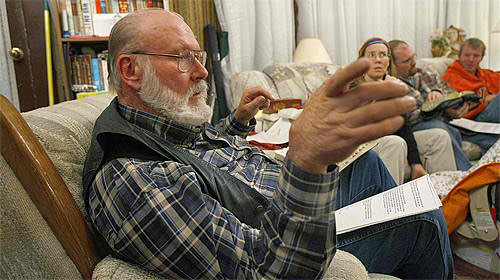
Debate Notice: Well-known ex-Mormon polygamist Leland Freeborn debates Bob Enyart, the author of this article and pastor of Denver Bible Church. See also the Mormon church acknowledging in 2014 that their founder Joseph Smith had up to 40 wives, with and without physical relations, to single and to otherwise married women, who were aged 14 to 56. Further, just as the Koran includes Mohammad's warning to his first wife that she faced eternal punishment for objecting to him lying with the young Coptic servant girl whom, allegedly, "Allah" had "made lawful" to him, so too, Joseph Smith dictated a similar warning to his first wife Emma in the founder's "inspired" Doctrine and Covenants.
What does the Bible say about polygamy? We will see that Jesus and the Apostle Paul opposed polygamy, as did Christians following the New Testament times. But then, why did it occur so often in Scripture? The practice was widespread among God's people in the Old Testament including the great patriarchs of the faith and it occurred in many other cultures. By the first century, the practice had become rare in the Roman and Greek worlds. Among the Jews in Palestine polygamy was prohibited by the prestigious school of Hillel, by the Dead Sea Qumran community, and was rare among rabbis, and discouraged by the sect of the Essenes, remaining only as a small subculture phenomenon and, though not explicitly stated, was practiced by Herod the Great. The Old Testament believers and other polygamists recorded in the Bible were Lamech, Abraham, Esau, Jacob, Ashur, Gideon, Elkanah, David, Solomon, Rehoboam, Abijah, Jehoram, Joash (Jehoiada), Ahab, Jehoiachin, Belshazzar, and Ahasuerus. Further, the Mosaic Law specifically permitted polygamy at Exodus 21:10, Leviticus 19:20 and Deuteronomy 21:15-17.
This article addresses the question of how God once could have permitted a practice that was later taught against by the Lord and by Paul and that countless modern believers have an innate disgust toward.
God officiated the first marriage by creating one woman for Adam. In establishing marriage He stated that "a man shall leave his father and mother and be joined to his wife, and they shall become one flesh" (Gen 2:24). In the New Testament, Jesus clarified this by saying, "the two shall become one flesh" and He then emphasized that by repeating, "they are no longer two, but one" (Mark 10:8). Further, the nearly balanced worldwide birth ratio of boys and girls provides evidence that God designed human beings for monogamy. For otherwise, if the world's culture did not enforce one-man, one-woman marriage, then if the richer men, and the more handsome men, and the more powerful men, took two and three wives each or more, then today there would simply be no women available for hundreds of millions of other men to even propose to. (The higher mortality among males explains the historic ratio estimated at 105 boys for every 100 girls born, and of course, tragically like all child killing, sex-selection abortion has further skewed the ratio.) On the other hand, the Old Testament has many references, negative, neutral, and even positive, to polygamy. Why then do Christians stand almost unanimously against a man simultaneously having two or more wives?
Jesus Christ: No known New Testament believer lived in polygamy and a careful look at Scripture indicates directly that, by New Testament times, polygamy was condemned.
Jesus taught that unless there were grounds for divorce, marrying "another" would be sinful. This teaching necessarily includes a prohibition of polygamy. For if by New Testament times it were still lawful to marry multiple wives, then it would be lawful to take another wife, regardless of whether or not there had been grounds for divorce. Thus if Jesus believed that polygamy were permitted, then His own teaching would have failed. Yet, we know He opposed polygamy because He said:
"I say to you, whoever divorces his wife, except for sexual immorality, [Greek: pornea, or fornication, which would include any violation of the marriage covenant] and marries another, commits adultery;"
- Matthew 19:9
When God permitted polygamy, of course the practice did not require evidence of unfaithfulness from an existing wife. So the Lord's teaching on divorce and remarriage inherently includes the prohibition of polygamy. Further, Jesus' teaching assumes a general knowledge that the practice was forbidden.
Is it possible, though, that God could change His law? Actually, as we teach in our Hierarchy of Hermeneutics study, God has on occasion changed the rules, His "house rules", that is, His economy (Greek: oikonomia; oikos house; nomos rule or law). For example, some of God's rules changed between the House of Israel and the Household of Faith (i.e., the Body of Christ), such as when He required the circumcision of the male child for Israel but prohibited it, as obedience to a religious covenant, for the Body. Here are two other examples of God changing the rules:
| Pre-flood Command (Vegetarian diet): "Of every tree... you may freely eat; but... of the tree of the knowledge of good and evil you shall not eat..." Gen. 1:29 | Post-flood (Now meat permitted): "Every moving thing that lives shall be food for you... But you shall not eat flesh with its life, that is its blood." Gen. 9:3-4 |
| Pre-flood (Death penalty forbidden): "Whoever kills Cain, vengeance shall be taken on him sevenfold."Gen. 4:15 |
Post-flood (Death penalty commanded): "Whoever sheds man's blood, by man his blood shall be shed... Gen. 9:6 |
Polygamy & Incest: Observing that God changed the rules is called dispensationalism, and this discipline helps believers to understand far more than just the difference in rules regarding polygamy. For example, when God created Adam and Eve, their children were to marry their own siblings. Cain and Seth did this, as did Abraham (Sarah was his half-sister) and countless others. The practice was healthy and led to life, because the degenerative effects of sin (from Adam's Fall) on the human genome had not yet taken its toll. Thus, children born to marriages of close relatives were not in danger of inheriting birth defects. Yet, after the passage of a few thousand years, mutations began to accumulate and by the time of Moses, siblings and other close relatives marrying and conceiving children would produce widespread and even lethal birth defects. (Like other post-flood ancient humans, Neanderthals matured slowly and had long lifespans. A 2017 study in the journal Science found that Neanderthals had been inbreeding, as seen from their genetic mutations, but as they disappeared by mating and merging into other ethnic groups, reproduction with close relatives was mostly discontinued. These genetic discoveries were easily predictable to students of the Scriptures.) So in mercy, by the time of Moses, God then prohibited the marriage of close relatives (Lev. 18), including not only siblings, but more generally, the marriage of many close relatives.
For God created us in such a way that when it became reproductively dangerous to marry close relatives, the human race would also develop a natural revulsion to the practice. This is a form of the gag reflex that God put in us. If a child dared another to eat decomposing vermin lying in the gutter, the natural reflex to gag at the very thought of it was put in children by God to protect them. (However, like ISIS despicably teaching young boys to behead captured soldiers, which is the most vile crime committed by this Islamic group, natural revulsions can be overcome by repeated efforts to become accustomed to a behavior that God otherwise designed us to despise.)
Thus, God made mankind in such a way that we could respond viscerally, even with disgust, to behavior that had previously been permitted. Incest is one example of this and polygamy is another.
After the Fall: After Adam and Eve sinned, the created paradise faded and sin and its consequences pervaded all aspects of the human experience, from marriage and child raising to commerce, and so on. God responded, for example, by permitting child discipline including spanking, which would not have been so from the beginning. He instituted and regulated criminal justice including restitution, flogging and the death penalty, which would not have been so from the beginning. In family law God regulated divorce (Ezra 10:3; Deut. 24:1; Mat. 5:32; etc.), which would not have been so from the beginning, as Jesus explicitly stated (Mat. 19:8). These responses to the reality of sin of course do not reflect God's original design for innocent mankind. As Jesus said, God permitted divorce, "for sexual immorality" (Mat. 5:32; 19:9; etc.) which includes abandonment (1 Cor. 7:4, 15, 9, 27-28; Ex. 21:10-11) for the marriage covenant is destroyed by sexual immorality which includes abandonment.
Thus God regulated behaviors that He had not originally designed: spanking, the death penalty, polygamy, slavery, etc. (See for example this author's article on Slavery in the Bible and God and the Death Penalty.) But why would God permit polygamy in Old Testament times? After the Fall, as an expression of man's disobedience to God, violence became ubiquitous, and after the global Flood, the earth itself became such a hostile place, and lawless, that women, the weaker vessel (1 Peter 3:7), simply could not survive on their own. Women around the world, generally speaking, effectively had only four options:
1. live in her father's house
2. live in her husband's house
3. live as a slave
4. live as a harlot
Outside of living in one of these circumstances, a woman faced only death. God permitted polygamy and concubinage, which is an expansion of option two above, out of mercy to women and because of the wonderful and intense desire He put within women to raise children. As in Scripture (and implied by scant secular archaeological extra-biblical references), in the centuries after the Flood life expectancies plummeted. (Incidentally, plummeting life expectancies explain why ancient rulers spent their lives and their massive wealth building their own burial tombs, obsessing about their deaths, thereby setting a precedent which other emperors later mimicked to show their grandeur.) Postdiluvian fathers died younger and younger, and the ruins of ancient walled cities still testify to how commonplace was the mass killing of men from plundered villages. So a woman needed a man to survive. And of course, Scripture never permitted polyandry, whereby a woman would have multiple husbands. However out of mercy toward women, God regulated polygamy.
By the time of the New Testament, mankind had progressed sufficiently so that even though any number of individual women may still have a hard time surviving on their own, the world was entering into a time when women could be supported by the infrastructure around them. Nimrod and Marx proposed the immoral solution of government providing for people. But God's plan was for individuals to be helped, if needed through no fault of their own, by the extended family, by fellow church members, by friends, and neighbors. Thus, as revealed by God through the writings of the Apostle Paul, we learn of standards of behavior that apply to all men, as given to church leaders, including self control, sobriety, and being at-most "the husband of one wife."
The Apostle Paul: With the teaching of Jesus Christ, the growing public opposition to polygamy had been codified by Him, God the Son, being inherently prohibited by the Lord's teaching against unjustified remarriage. But this opposition to polygamy appears also in the epistles of the Apostle Paul. The standards of morality (like self-control and humility) for bishops, elders, and deacons in the letters written to Timothy and Titus apply not only to church leaders, but to all Christians (and thus, to everyone living a law-abiding life).
Atheists and other Bible critics (and even some confused Christians), claim that verses like those cited below imply that polygamy was allowed by the New Testament apostle Paul for ordinary Christians, because he prohibited it only for leaders. If that interpretation were valid, however, then Paul was also saying that generally it would be fine for Christians to be violent, greedy for money, quarrelsome, and to have unruly children, which is nonsense. Paul's standards for elders can not conceivably support such a twisted claim. And likewise, the Bible's command against adultery with a neighbor's wife, of course (!), does not permit adultery with a neighbor's husband. That kind of error illustrates a false antithesis like the logical fallacy of the excluded middle, what KGOV.com calls the "false opposite." Just because the text speaks of wives, does not infer that the principle is inapplicable to husbands. Likewise, because Paul prohibits being violent for leaders does not mean that he supports it for followers. For Paul wrote that church leaders:
must be blameless, the husband of one wife, temperate, sober-minded, of good behavior, hospitable, able to teach; not given to wine, not violent, not greedy for money, but gentle, not quarrelsome, not covetous; one who rules his own house well, having his children in submission with all reverence... 1 Timothy 3:2-5
The primary difference between church members and church leaders is that, in order to be appointed a leader and maintain that office in good standing, a church leader must actually live the Christian life. The prohibition of polygamy in the New Testament for church leaders does not present a "higher" standard of holiness for bishops, for there is only one standard of holiness: being conformed to the image of Jesus Christ. As presented in the epistles, holiness includes sober living and self-control. Are these behaviors only recommended for pastors, whereas other church members are permitted to drunken outbursts of anger? No. Of course not. When the biblical standards for elders prohibit polygamy and require leading an orderly household, that does not mean that God is satisfied with others having disorderly households and nor that He permits them to raise disrespectful children.
Condemnation of Promiscuity: The biblical requirement that a church leader be the husband of one wife translates literally from the Greek phrase as a one-woman man. That idiomatic expression for monogamy also serves as a general condemnation of promiscuity. This is important to realize. For otherwise, the Bible's qualifications for leaders would have omitted reference to and warning against what is, sadly, one of the leading disqualifiers to leadership, namely, sexual immorality. However, the scriptures do address such immorality by way of this dual-purpose expression. An elder must be a one-woman man, that is, not a polygamist, not an adulterer, not a womanizer. One-womanness, so-to-speak, had essentially become an idiomatic expression capturing the entire range of sexual purity.
...not a novice, lest being puffed up with pride he fall into the same condemnation as the devil. Moreover he must have a good testimony among those who are outside, lest he fall into reproach and the snare of the devil. Likewise deacons must be reverent, not double-tongued, not given to much wine, not greedy for money, holding the mystery of the faith with a pure conscience. But let these also first be tested; then let them serve as deacons, being found blameless. Likewise, their wives must be reverent, not slanderers, temperate, faithful in all things. Let deacons be the husbands of one wife, ruling their children and their own houses well. 1 Timothy 3:6-12
Notice two things about the two passages, in Timothy and Titus, that present to the world the standards of leadership. The Old Testament is not mostly about Gentiles, but mostly about Israel (including regarding polygamy). Contrariwise, the two passages in the Bible that explain the standards for leadership, not in Israel, but in the Body of Christ, are both written by the Apostle Paul. For as he wrote, to those of us who are Gentiles, "you Gentiles—if indeed you have heard of the dispensation of the grace of God which was given to me for you..." (Ephesians 3:1-2). So first, wherever the law changed between Israel and the Body, between the Covenant of Law and the Covenant of Grace, expect to find indications of that change especially in Paul's writings, through whom God commanded us to "rightly divide the word of truth" (2 Timothy 2:15). Thus, whereas God commanded the Israelites to divorce their wives who were outside of God's covenant, in his first epistle to the Corinthians, God inspires Paul to prohibit members of the Body of Christ from divorcing unbelieving spouses (thus Paul taught this, and not Jesus, for Jesus was sent only ot the lost sheep of the house of Israel, Mat. 15:24).
Secondly, notice that, after the first requirement, which is a generic overview, of being "blameless", both of Paul's passages, to Timothy and to Titus, begin with one-womanness, that is, with being a one-woman-man, or, as translated, "the husband of one wife":
...appoint elders in every city as I commanded you— if a man is blameless, the husband of one wife, having faithful children not accused of dissipation or insubordination. For a bishop must be blameless, as a steward of God, not self-willed, not quick-tempered, not given to wine, not violent, not greedy for money, but hospitable, a lover of what is good, sober-minded, just, holy, self-controlled, holding fast the faithful word as he has been taught, that he may be able, by sound doctrine, both to exhort and convict those who contradict. Titus 1:5-9
And of course, God commanded that Timothy (1 Tim. 4:12) "be an example to [all] the believers" and Titus "be a pattern of good works" (Titus 2:7), again making the obvious explicit, that these standards apply not just to leaders but to all believers, and indeed, to everyone whether in the Body of Christ or not.
Mosaic Law Symbolism: Similarly, in the Mosaic Law, there is not a higher standard of holiness for priests, although God does impose upon them various symbolic ordinances to point forward to the great high priest, Jesus Christ. For, just like the standards for bishops and deacons, the Levitical priesthood could not require a higher standard of holiness because the only valid standard of holiness, for all believers, is God Himself. There can be no standard higher than Him. Three times Luke refers to Him as the Highest. What then of the qualifications for the priesthood? The Bible student can easily identify the symbolism in the priestly regulations of Leviticus 21, and realizes that they do not infer something that does not and cannot exist, namely, a higher standard of righteousness:
| Requirement | Symbolism |
| No blind priests | In Jesus the blind see (John 9:7) |
| No lame priests | In Jesus the lame walk (John 5:9) |
| Do not tear clothes | Jesus’ robe is not torn (John 19:24) |
| No broken hands/feet | Jesus’ bones were not broken (Ps. 34:20; 22:17; John 19:33) though his hands and feet were pierced (Ps. 22:16) |
| Do not marry a harlot | Don’t join Christ to a harlot (1 Cor. 6:15) |
| No divorcees/widows | Christ’s Bride is a virgin (Mat. 25:1) |
| No eunuchs | Christians should multiply (Mat. 28:19; 13:23) |
| Defective eye | Jesus gives eye salve (Rev. 3:18) |
| Covered head | Jesus is the head (1 Cor. 11:3) |
| Always in the sanctuary | Jesus ever lives to make intercession (Heb. 7:24-25) |
| Do not touch the dead | Jesus frees from death, and the sting of sin is death (1 Cor. 15) |
The qualifications and regulations for priests do not imply a higher standard of righteousness, for there is no such thing. Therefore also, because there can be no higher standard of righteousness for church leaders, the New Testament's prohibition for polygamy among church leaders applies also to all believers. Thus traditional Christian teaching opposes thievery, murder, drunkenness, and polygamy.
Following this clear understanding of the teachings of Jesus Christ and of Paul the early church condemned polygamy in its writings. We see this prohibition in the writings of Justin Martyr (160 A.D.), Irenaeus (180 A.D.), Tertullian (207 A.D.), Methodius (290 A.D.), the Council of Neocaesarea (315 A.D.), etc. So God reaffirmed his original intent of marriage being between one man and one woman through the Lord and through his Apostle to the Gentiles.
by Bob Enyart
KGOV.com
See Also: See Pastor Enyart's article on Slavery in the Bible, his debate with a well-known Mormon polygamist Leland Freeborn, and the tragic case of the Mormon church acknowledging that abortion is murder but officially consenting to the killing of handicapped children and others. Also, hear Bob Enyart's interview with Newsweek's Lisa Miller, rebutting her cover story about homosexual marriage during which Bob caught her red-handed, having intentionally misrepresented the Bible when instead of quoting Scripture directly, Ms. Miller quoted a secondary source that she knew to be incorrect.