* Work Like an Egyptian: to pay off the national debt. Bob tells of his visit with his wife Cheryl and their three youngest home-schooled boys to National Geographic's fabulous King Tut exhibit at the Denver Art Museum. (This visit was shortly after a museum official treated Bob and friends to a wonderful dinner at their Palette's restaurant in the museum itself: a great time was had by all!)
* The Term Pharaoh and the Biblical Perspective: The scriptural perspective of man, history, and civilization is greatly reinforced by Egyptology. For many examples, see rsr.org/egypts-evidence-for-the-exodus and for another, consider that...
* The Hebrews Gave the Term "Pharaoh" to the World: The very term Pharaoh, for Egypt's Kings, is not a word of Egyptian origin but the title comes from a Hebrew word that describes an Egyptian phrase for palace, which word appears repeatedly in the books of Moses in the Scriptures. That the term Pharaoh is Hebrew and not Egyptian (although even Egypt then adopted it) is learned in the first exhibit in National Geographic's King Tut world tour. Believing the King Tut exhibit to be correct on the derivation of the word Pharaoh (in part because National Geographic is not biased toward the Bible), then the online etymology and the Wikipedia entry do not convey this etymology very well.) 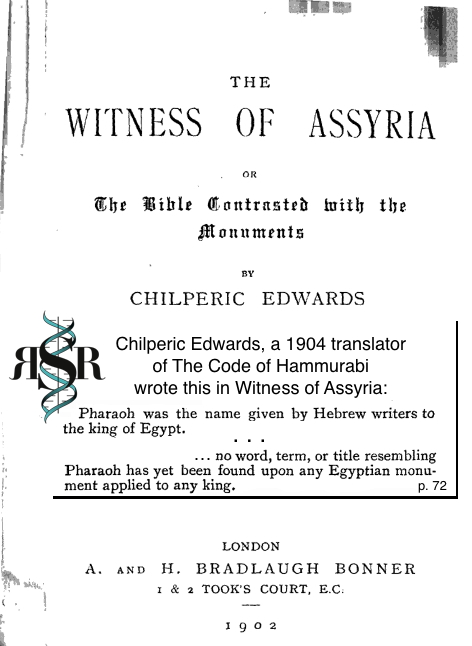 So the world speaks the particular word Pharaoh, not from the Egyptian language, but from the Hebrew and because of the Bible which uses the word more than 200 times. This is a tiny example of the observation that all of human history, language, and knowledge is comprehensible only in light of God's Word.
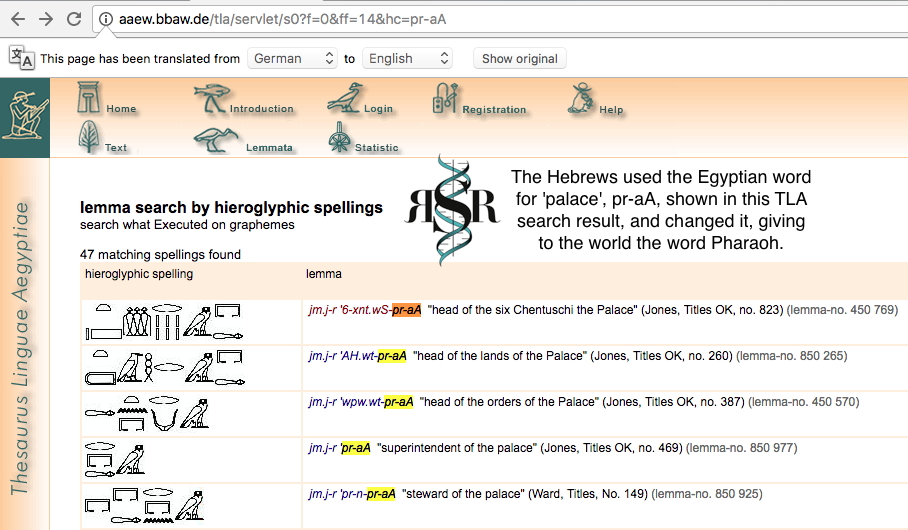
* Scholar Chilperic Edwards on Pharaoh as a Hebrew Word: Chilperic Edwards, translator of the Code of Hammurabi, stated regarding the non-Egyptian origin of the name of Pharaoh:
"Pharaoh was the name given by Hebrew writers to the king of Egypt. ... It has been pretended that [the word Pharaoh] is a corruption of the Egyptian pa-oura, which is said to mean "the king". But ur, or oura, simply means a chief, or headman, and has not yet been found applied to any monarch. ...no word, term, or title resembling Pharaoh has yet been found upon any Egyptian monument applied to any king."
Edwards is referenced here because he succinctly states that "Pharaoh" is not an Egyptian word for their king but is a Hebrew word. However, he was not keen on the idea that the Hebrew word "Pharaoh" had derived from the Egyptian pr-aA, "great house". Regardless though of his opinion on the etymology of the Hebrew word, the significance is that he recognizes that "Pharaoh" is not an Egyptian word, and that it was not an Egyptian term for their king.
Why is this important? Almost all secular scholars join with those who reject the historical basis for the Exodus in discounting any significant role for the Jews in ancient Egypt. However, consider that the Hebrews gave to the ancient world, and eventually even to the ancient Egyptians themselves, the term Pharaoh. Just as "White House" refers to the leader of the United States, "Today the White House proposed...", so too because of the Jews, the entire world uses the word Pharaoh, from the King's palace, pr-aA, as a metaphor for the King of Egypt, because of the Hebrews.
* What If the Name Ramses Had a Similar Origin? The name Ramses means born of Ra, the sun god. Early in Egypt's history, by the Fifth Dynasty (~2500 - 2350 B.C.) the Pharaoh was said to be the son of Ra. Joseph's initial years in Egypt led to his exaltation by Pharaoh. Easily he could then have described to his family this land by using an Egyptian term, "of him who was born of Ra", that is, the "the land of Rameses" (Gen. 47:11). That same chapter, Genesis 47, explains that even "the land became Pharaoh’s". So in the telling of those events, Egypt really had become "the land of Rameses". If the Jews were the ones who popularized this name, then the references to Ramses in Genesis 47:11 and Exodus 1:11 would not even be anachronisms. For then, as with Goshen and the term Pharaoh itself, the Jews would be the source of the name Ramses too. And the New Kingdom's Ramses Dynasty may have taken it's name (like da Vinci, etc.), from the place of its origin, rather than the reverse. If ever established, of course, this would wreak havoc among Moses' critics.

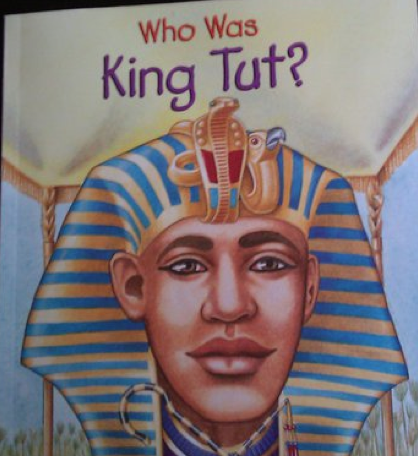
* Baracktut Obamankhamun: Oh yeah, and there was just something about the book on Tutankhamun (see the cover above) that reminded us, and everyone else in the gift shop, of Obamankhamun...